(I originally wrote and posted this on my previous blog on 03/15/2007.)
Reading: Yehezqel (Ezekiel) 3-5
Eze 3:17 "Son of man, I have made you a watchman for the house of Yisra'el. And you shall hear a word from My mouth, and shall warn them from Me.
Eze 3:18 "When I say to the wrong, 'You shall certainly die,' and you have not warned him, nor spoken to warn the wrong from his wrong way, to save his life, that same wrong man shall die in his crookedness, and his blood I require at your hand.
Eze 3:19 "But if you have warned the wrong and he does not turn from his wrong, nor from his wrong way, he shall die in his crookedness, and you have delivered your being.
Eze 3:20 "And when a righteous one turns from his righteousness and shall do unrighteousness, when I have put a stumbling-block before him, he shall die. Because you did not warn him, he shall die in his sin, and his righteousness which he has done is not remembered, and his blood I require at your hand.
Eze 3:21 "But if you have warned the righteous one that the righteous should not sin, and he did not sin, he shall certainly live because he has been warned, and you have delivered your being."
This passage is very thought-provoking. Especially considering that the Jews call those who believe in Yeshua as Messiah 'Notzrim', which means 'watchmen', this is a message we need to listen to and take to heart.
The wrong AND the righteous are to be warned to turn from sin. When you think about it, that includes everyone!
Compare the above instruction given to Yehezqel to the instruction given to the disciples:
Mar 16:15 And He said to them, "Go into all the world and proclaim the Good News to every creature.
Mar 16:16 "He who has believed and has been immersed, shall be saved, but he who has not believed shall be condemned.
Shaul (Paul) obviously took these instructions to heart and was faithful to obey them:
Act 20:26 "Therefore I witness to you this day that I am clear from the blood of all.
Act 20:27 "For I kept not back from declaring to you all the counsel of Elohim.
Act 20:31 "Therefore watch, remembering that for three years, night and day, I did not cease to warn each one with tears.
Reading these passages scared me because, unlike Shaul, I have not been faithful to this charge and have held back from sounding the watchman's warning in order to avoid conflict or due to a myriad of other excuses.
But if we saw someone walking into a minefield, wouldn't we warn them and plead with them to turn back? I realize that we cannot force people to listen or to take heed, but according to the Scriptures we are still responsible to sound the warning, "whether they hear, or whether they refuse".
Saturday, July 26, 2008
Being a Watchman
Labels:
The Scriptures


Monday, July 21, 2008
The Simple Woman's Daybook

(*these recipes are from 'Fix-It and Forget-It Lightly' by Phyllis Pellman Good)
Here is a picture thought I am sharing...

Saturday, July 19, 2008
Princess to Slave
(I originally wrote and posted this to my previous blog on 03/14/2007.)
Reading: Ekah (Lamentations) 1-2
Lam 1:1 How alone she sits, The city once great with people! Like a widow she has become, One great among the nations! A princess among provinces has become a slave!
This book is called Ekah in Hebrew, which means "how", and is a collection of 'songs of wailing', or dirges, about the destruction of Yerushalayim. It has an interesting construction. The first four chapters are in acrostic style with each verse (in chapter 3 it is each trio of verses) beginning with a letter of the Hebrew alphabet in alphabetical order. Some Psalms (25, 34, 37, 119) are also in this style. Even though the fifth chapter of Ekah has 22 verses (the number of letters in the Hebrew alefbet), it is not in the same alphabetical acrostic style as the others.
Lam 2:14 Your prophets have seen Falsehood and folly for you, And have not shown you your crookedness, To turn back your captivity. But their visions for you Are false and misleading messages.
The saddest thing about the destruction of Yerushalayim and the exile to Babel is how the leaders led the people astray instead of calling them to repentance. They continued to tell them that everything was fine instead of pointing out their sin so they could turn from it. We have this same problem today. Leaders tickle the peoples' ears instead of calling them to repentance.
The Day of Judgment will come for each and every one of us. YHWH is extremely patient, but that Day will come, and the books will be opened, and each of us will go on trial. The writer of the book of Ibrim (Hebrews) gives us a preview:
Heb 10:26 For if we sin purposely after we have received the knowledge of the truth, there no longer remains a slaughter offering for sins,
Heb 10:27 but some fearsome anticipation of judgment, and a fierce fire which is about to consume the opponents.
Heb 10:28 Anyone who has disregarded the Torah of Mosheh dies without compassion on the witness of two or three witnesses.
Heb 10:29 How much worse punishment do you think shall he deserve who has trampled the Son of Elohim underfoot, counted the blood of the covenant by which he was set apart as common, and insulted the Spirit of favour?
Heb 10:30 For we know Him who has said, "Vengeance is Mine, I shall repay, says יהוה." And again, "יהוה shall judge His people."
Heb 10:31 It is fearsome to fall into the hands of the living Elohim.
How can we expect the blood of Messiah to cover us if we're trampling Him underfoot? He told the woman caught in adultery to "Go and sin no more." He did not die and shed His blood for us so that we could treat it as an unholy thing. He wants us to walk as He walked and "sin no more" so that we can live with Him in the New Yerushalayim--
Rev 22:14 "Blessed are those doing His commands, so that the authority shall be theirs unto the tree of life, and to enter through the gates into the city.
Rev 22:15 "But outside are the dogs and those who enchant with drugs, and those who whore, and the murderers, and the idolaters, and all who love and do falsehood.
I don't think any of us wants to end up singing dirges as Yirmeyahu and the rest of Yehudah did, so we need to listen to the Word of YHWH and turn to Him and away from sin.
Labels:
The Scriptures
Saturday, July 12, 2008
Rebels
(I originally wrote and posted this to my previous blog on 03/13/2007.)
Reading: Yehezqel (Ezekiel) 1-2
Yehezqel was a priest during the time of the exile of Yehudah, and his book begins with some amazing visions. Even with Yehezqel's detailed descriptions, it is still difficult to picture what he saw, but his reaction is very easy to identify with:
Eze 1:28 As the appearance of a rainbow in a cloud on a rainy day, so was the appearance of the brightness all around it. This was the appearance of the likeness of the esteem of יהוה. And when I saw it, I fell on my face, and I heard a voice of One speaking.
I think we can all imagine falling on our faces upon seeing the "likeness of the esteem of יהוה"!
The Voice tells Yehezqel that He is sending him to the children of Yisra'el and gives him instructions:
Eze 2:4 "And the children are stiff of face and hard of heart to whom I am sending you, and you shall say to them, 'Thus said the Master יהוה.'
Eze 2:5 "And they - whether they hear or whether they refuse, for they are a rebellious house - shall know that a prophet has been in their midst.
Eze 2:6 "And you, son of man, do not be afraid of them, nor be afraid of their words, though thistles and thorns are with you and you dwell among scorpions. Do not be afraid of their words or discouraged by their looks, for they are a rebellious house.
Eze 2:7 "And you shall speak My words to them, whether they hear or whether they refuse, for they are rebellious.
Eze 2:8 "And you, son of man, hear what I am speaking to you. Do not be rebellious like that rebellious house, open your mouth and eat what I am giving you."
This phrase is spoken twice: "whether they hear or whether they refuse". Yehezqel is to go to the rebellious and speak what He gives him to speak whether they have ears to hear or not and no matter what threats they make and no matter how many dirty looks they give him.
It seems that especially when one is in the company of the rebellious, it is a challenge to know when to speak and when to remain silent. It can be very uncomfortable. Sometimes we will get 'looks' even when we are silent. And often it seems like there is no point because previous experience has shown that rebels don't want to hear what the Scriptures have to say.
But here YHWH is telling Yehezqel to speak to the rebellious anyway simply because He is telling him to, "whether they hear or whether they refuse".
It is not our responsibility to coerce the rebellious into hearing His Word, but it IS our responsibility to obey YHWH and speak His Word whenever and to whomever He tells us to, regardless of their reaction, and in order to do that, we need to eliminate any rebellion in our own hearts.
Labels:
The Scriptures
Monday, July 7, 2008
The Simple Woman's Daybook
Outside My Window...
I am thinking...
I am thankful for...
From the kitchen...
I am wearing...
I am creating...
I am going...
I am reading...
I am hoping...
I am hearing...
Around the house...
One of my favorite things...
A Few Plans For The Rest Of The Week:
Here is a picture thought I am sharing...

If you would like to participate in The Simple Woman's Daybook, visit Peggy's blog, The Simple Woman, and read the guidelines here.
Saturday, July 5, 2008
Mystery Of The Ark Of The Covenant
(I originally wrote and posted this to my previous blog 03/13/2007.)
Reading: YirmeYahu (Jeremiah) 52
This last chapter of YirmeYahu is a sad one with the destruction of the temple and Yerushalayim and the execution of many of the leaders of Yehudah by the sovereign of Babel.
The army of Babel ransacked the temple and took all the items of gold, silver and bronze. But notably missing from the plunder is the ark of the covenant. In the book of 2 Maccabees (part of the Apocrypha), we are told that YirmeYahu hid the ark of the covenant:
2Ma 2:4 It was also contained in the same writing, that the prophet, being warned of God, commanded the tabernacle and the ark to go with him, as he went forth into the mountain, where Moses climbed up, and saw the heritage of God.
2Ma 2:5 And when Jeremy came thither, he found an hollow cave, wherein he laid the tabernacle, and the ark, and the altar of incense, and so stopped the door.
2Ma 2:6 And some of those that followed him came to mark the way, but they could not find it.
2Ma 2:7 Which when Jeremy perceived, he blamed them, saying, As for that place, it shall be unknown until the time that God gather his people again together, and receive them unto mercy.
There are other clues as to how the ark may have been hidden.
1Ki 7:8 And the house where he was to dwell, in the other courtyard, within the hall was of like workmanship. And Shelomoh made a house like this hall for Pharaoh's daughter, whom he had taken.
Shelomoh (Solomon) married Pharaoh's daughter. Could it be that he made this alliance in order to obtain the secrets of the building of the pyramids with all of their underground networks and chambers? If he obtained the technology of Mitsrayim (Egypt), perhaps he used it in the building of the temple on the temple mount.
Another clue is the 'before' and 'after' pictures of the two columns of bronze. Here is the 'before' picture of the two columns when they are built:
1Ki 7:15 And he cast two columns of bronze, each one eighteen cubits high, and a line of twelve cubits measured the circumference of each.
1Ki 7:16 And he made two capitals of cast bronze, to put on the tops of the columns - the height of one capital was five cubits, and the height of the other capital was five cubits -
Here is the 'after' picture of the two columns when the army of Babel destroyed the temple:
2Ki 25:16 The bronze of all these utensils was beyond measure - the two columns, the one Sea, and the stands, which Shelomoh had made for the House of יהוה.
2Ki 25:17 The height of one column was eighteen cubits, and the capital on it was of bronze. And the height of the capital was three cubits, and the network and pomegranates all around the capital were all of bronze. And the second column was the same, with a network.
The height of the capitals is initially 5 cubits, but when the plunderers take them away, the capitals are only 3 cubits tall. What happened to the other 2 cubits? One theory is that these hollow columns housed lever-type machinery to facilitate the lowering of the ark of the covenant into a hidden chamber under the temple.
There is one problem, though. In YirmeYahu's listing of the items taken from the temple during its destruction, he describes the capitals as being 5 cubits tall--the same measurement as when they were originally made:
Jer 52:20 The two columns, one Sea, the twelve bronze bulls which were under it, and the stands, which Sovereign Shelomoh had made for the House of יהוה - the bronze of all these vessels was beyond weighing.
Jer 52:21 As for the columns, the height of one column was eighteen cubits, and its circumference was twelve cubits, and its thickness was four fingers, hollow.
Jer 52:22 And a capital of bronze was on it. And the height of one capital was five cubits, with a network and pomegranates all around the capital, all of bronze. And the second column, with pomegranates was the same.
What occurred to me is that if YirmeYahu did facilitate the hiding of the ark of the covenant and if that hiding was done through some secret involving those two columns and their capitals, it would make sense for him to use the original measurements in his description rather than give away the secret.
Perhaps one day we will know what happened to the ark of the covenant. Maybe it will be as the writer of Maccabees quotes YirmeYahu--"it shall be unknown until the time that God gather his people again together, and receive them unto mercy."
Labels:
The Scriptures
Wednesday, July 2, 2008
That's My Answer

Labels:
That's My Answer,
The Scriptures,
TV
Tuesday, July 1, 2008
Home Of The Brave
 This movie was okay, not great, but okay. It focuses on the return home of four veterans of the Iraq war.
On the positive side, I think it helped me to better understand why my son, also a veteran of the same war, wanted to go back to Iraq, something I certainly didn't want him to do after sweating it out until he finally came home safely. (His birthday is today--Happy Birthday, sweetheart!)
While watching the movie, I ended up revisiting my now 5-year-long anger and frustration with this war. To this day, I still don't know why all the insanity hasn't been decisively dealt with and put down.
For instance, the movie depicts the soldiers on a HUMANITARIAN mission into a village to deliver supplies when they are attacked and bombed by 'insurgents'. To my way of thinking, any village harboring such 'insurgents' who kill our people doesn't need our humanitarian aid and shouldn't get any until they turn over said 'insurgents'.
There is a perfect example in the Scriptures of how such situations should be handled. When Sheba was in rebellion against King David and hiding in Abel, Israel's army with Yoab as its leader, besieged the city of Abel until Sheba's head was thrown over the wall to him. This was facilitated by a wise woman of Abel, and then the army left the city in peace. (This story is in 2 Samuel 20).
Labels:
Family,
Movies,
The Scriptures
Monday, June 30, 2008
The Simple Woman's Daybook
FOR TODAY...Yom Sheni, the 26th day of the 3rd month
Outside My Window...
I am thinking... about the heavy work day I have ahead of me.
I am thankful for... the love of my family.
From the kitchen... This week's dinners:
Slow-Cooker Barbecued Chicken*
Beef Burgundy*
Stew in a Snap*
Barbecued Chicken Breasts*
Steak with Mashed Potatoes*
CC (Company's Coming) Roast*
Cheeseburger Macaroni
(*these recipes are from 'Fix-It and Forget-It Lightly' by Phyllis Pelman Good.)
I am wearing... a dark blue dress.
I am creating... the Shining Star baby blanket and an afghan square to represent the book, 'Knit One, Kill Two' by Maggie Sefton, for My Reading Afghan.
I am going... to town to go shopping, but not until Preparation Day.
I am reading...
Daily for this week: Yeshayahu (Isaiah) 38-51; Mikah 1-7; Dibre HaYamim Bet (2 Chronicles) 32
Rosh Chodesh: Bemidbar (Numbers) 28:1-15; Shemuel Alef (1 Samuel) 20:18, 42; Yeshayahu (Isaiah) 66; Kefa Alef (1 Peter) 2:4-10
Chukat (Statute): Torah--Bemidbar (Numbers) 19:1-22:1; Haftarah--Mishpatim (Judges) 11:1-33; Ketuvim Netzarim--Yochanan (John) 3:10-21; Ibrim (Hebrews)9:11-28
Middlesex by Jeffrey Eugenides
I am hoping... to meet my work quotas.
I am hearing... the evaporative coolers on 'high'.
Around the house... I realize that I need to get all the mending done before I tackle dejunking.
One of my favorite things... is being able to come back into the cooler house after being outside where it is very hot right now.
A Few Plans For The Rest Of The Week:
I'm so overwhelmed with my job right now that I won't be able to focus on anything else until tomorrow.
Here is a picture thought I am sharing...

If you would like to participate in The Simple Woman's Daybook, visit Peggy's blog, The Simple Woman, and read the guidelines here.
Saturday, June 28, 2008
Guard And Do
(I originally wrote and posted this to my previous blog on 03/12/2007.)
Reading: MattithYahu (Matthew) 21-24
Mat 23:1 Then Yeshua spoke to the crowds and to His taught ones,
Mat 23:2 saying, "The scribes and the Pharisees sit on the seat of Mosheh.
Mat 23:3 "Therefore, whatever they say to you to guard, guard and do. But do not do according to their works, for they say, and do not do.
What is the "seat of Mosheh"? And why did Yeshua Messiah instruct his followers to "guard and do" whatever the scribes and Pharisees say when they are sitting on the seat of Mosheh?
Mosheh is representative of Torah, which is the Word of YHWH, so when the scribes and Pharisees are teaching from the "seat of Mosheh" (as Mosheh taught), then Yeshua Messiah wants His followers to guard and do what they say, i.e. follow Torah, which is following Him since He is the Living Torah.
Yeshua Messiah goes on to reveal the hypocrisy of the scribes and Pharisees and why we are not to do as they do, but rather only guard and do what Mosheh and Messiah teach and not all the man-made laws that the scribes and Pharisees added to the Torah, which He calls heavy burdens:
Mat 23:4 "For they bind heavy burdens, hard to bear, and lay them on men's shoulders, but with their finger they do not wish to move them.
In contrast, His Torah is a gentle yoke and light burden:
Mat 11:30 "For My yoke is gentle and My burden is light."
Yeshua Messiah goes on to describe the hypocrisies of the scribes and Pharisees:
Mat 23:5 "And they do all their works to be seen by men, and they make their t'fillen wide and lengthen the tzitziyot of their garments,
He criticizes them for unnecessarily enlarging their tefillin and tzitziyot (to be better seen by men), but He doesn't criticize them for wearing tefillin and tzitziyot because the wearing of these is Scriptural:
Deu 6:6 "And these Words which I am commanding you today shall be in your heart,
Deu 6:7 and you shall impress them upon your children, and shall speak of them when you sit in your house, and when you walk by the way, and when you lie down, and when you rise up,
Deu 6:8 and shall bind them as a sign on your hand, and they shall be as frontlets between your eyes.
Num 15:38 "Speak to the children of Yisra'el, and you shall say to them to make tzitziyot on the corners of their garments throughout their generations, and to put a blue cord in the tzitzit of the corners.
Num 15:39 "And it shall be to you for a tzitzit, and you shall see it, and shall remember all the commands of YHWH and shall do them, and not search after your own heart and your own eyes after which you went whoring,
Num 15:40 so that you remember, and shall do all My commands, and be set-apart unto your Elohim.
Tefillin are small scrolls of selected Scriptures bound to the hand and forehead. Tzitziyot (plural of tzitzit) are tassels worn on the corners of garments. It was the tzitzit of Yeshua's garment that the woman with the issue of blood was reaching for:
Luk 8:43 And a woman, having a flow of blood for twelve years, who, having spent all her livelihood on physicians, was unable to be healed by any,
Luk 8:44 came from behind and touched the tzitzit of His garment. And immediately her flow of blood stopped.
Yeshua describes yet another hypocrisy of the scribes and Pharisees:
Mat 23:23 "Woe to you, scribes and Pharisees, hypocrites! Because you tithe the mint and the anise and the cumin, and have neglected the weightier matters of the Torah: the right-ruling and the compassion and the belief. These need to have been done, without neglecting the others.
He affirms that the Torah of tithing is to be done, but He condemns their failure to guard and do the rest of Torah.
The scribes and Pharisees had become blind guides and hypocrites, a brood of vipers, because they failed to guard Torah. They added to it the commands of men, forsaking the command of YHWH.
Mar 7:6 And He answering, said to them, "Well did Yeshayahu prophesy concerning you hypocrites, as it has been written, 'This people respect Me with their lips, but their heart is far from Me.
Mar 7:7 And in vain do they worship Me, teaching as teachings the commands of men.'
Mar 7:8 "Forsaking the command of Elohim, you hold fast the tradition of men."
Yeshua Messiah wants us to guard His commands:
Joh 14:15 "If you love Me, you shall guard My commands.
Yochanan (John) tells us that this is how we know that we are in Him:
1Jo 2:3 And by this we know that we know Him, if we guard His commands.
1Jo 2:4 The one who says, "I know Him," and does not guard His commands, is a liar, and the truth is not in him.
1Jo 2:5 But whoever guards His Word, truly the love of Elohim has been perfected in him. By this we know that we are in Him.
1Jo 2:6 The one who says he stays in Him ought himself also to walk, even as He walked.
1Jo 2:7 Beloved, I write no fresh command to you, but an old command which you have had from the beginning. The old command is the Word which you heard from the beginning.
The key to understanding the Ketuvim Netzarim (Nazarene Writings, also known as the New Testament) is to study Torah (the commandments of YHWH) in order to discern the commandments of YHWH from the commandments of men.
Heb 13:8 Yeshua Messiah is the same yesterday, and today, and forever.
Labels:
The Scriptures
Friday, June 20, 2008
"Come Out Of Her, My People!"
(I originally wrote and posted this to my previous blog on 03/09/2007.)
Reading: YirmeYahu (Jeremiah) 49-51
Three times in the book of YirmeYahu, YHWH warns His people to flee Babel (Babylon), and it is this same warning that is repeated in Revelation:
Jer 50:8 "Flee from the midst of Babel, come out of the land of the Chaldeans. And be as rams before a flock.
Jer 51:6 Flee from the midst of Babel, and let each one save his life! Do not be cut off in her crookedness, for this is the time of the vengeance of יהוה, the recompense He is repaying her.
Jer 51:45 "Come out of her midst, My people! And let everyone deliver his being from the burning displeasure of יהוה.
Rev 18:4 And I heard another voice from the heaven saying, "Come out of her, my people, lest you share in her sins, and lest you receive of her plagues.
What we know from the Scriptures is that YHWH/Yeshua did a lot more than has been written in the Scriptures--
Joh 21:25 Now there is much else that Yeshua did. If every one of them were written down, I think that the world itself would not contain the written books. Amen. But we can be assured that what has been written is everything we need to know--
2Pe 1:3 as His Mighty-like power has given to us all we need for life and reverence, through the knowledge of Him who called us to esteem and uprightness.
So, then, why is this warning to flee Babel repeated multiple times? No doubt it is because our Savior wants us to heed and obey this warning!
What is Babel's crookedness? What are her sins? Why is YHWH so displeased with her and taking vengeance on her?
 Rev 17:5 and upon her forehead a name written, a secret: BABEL THE GREAT, THE MOTHER OF THE WHORES AND OF THE ABOMINATIONS OF THE EARTH.
The whole story of the Scriptures is about a Bridegroom and His bride--
Eph 5:31 "For this cause a man shall leave his father and mother and be joined to his wife, and the two shall become one flesh."
Eph 5:32 This secret is great, but I speak concerning Messiah and the assembly.
Eph 5:33 However, you too, everyone, let each one love his own wife as himself, and let the wife see that she fears her husband.
 The Bridegroom is extremely jealous and, in fact, says His Name is jealous--
Exo 34:14 for you do not bow yourselves to another mighty one, for יהוה, whose Name is jealous, is a jealous El –
He wants His bride to have eyes only for Him, to reserve her heart only for Him, to serve only Him:
Exo 20:2 "I am יהוה your Elohim, who brought you out of the land of Mitsrayim, out of the house of slavery.
Exo 20:3 "You have no other mighty ones against My face.
Exo 20:4 "You do not make for yourself a carved image, or any likeness of that which is in the heavens above, or which is in the earth beneath, or which is in the waters under the earth,
Exo 20:5 you do not bow down to them nor serve them. For I, יהוה your Elohim am a jealous El, visiting the crookedness of the fathers on the children to the third and fourth generations of those who hate Me,
Exo 20:6 but showing kindness to thousands, to those who love Me and guard My commands.
Idolatory is whoring and abomination to the King of Kings, and that is why He is taking vengeance on the mother of whores and abominations for leading His bride astray.
 One day He is coming to take His bride to the place He has prepared for her. The bride needs to prepare herself. She needs to take down all the altars she has built to false gods. She needs to smash all the idols she has allowed to creep into her heart. She needs to subject herself to Messiah and ask Him to set her apart and cleanse her with the washing of water by the Word (Ephesians 5:24-27).
 Rev 19:7 "Let us be glad and rejoice and give Him praise, for the marriage of the Lamb has come, and His wife prepared herself."
Rev 19:8 And to her it was given to be dressed in fine linen, clean and bright, for the fine linen is the righteousnesses of the set-apart ones.
(Babel, or Babylon, is the abomination of adultery, spiritual adultery, which is idolatry. Idolatry is when we esteem anyone or anything greater than YHWH, when we put anyone or anything ahead of Him. Also, when we pursue other 'gods' along with Him, like a wife having lovers in addition to her husband. )
Labels:
The Scriptures
Friday, June 13, 2008
Shavuot (Weeks)

Shavuot is traditionally celebrated as the time when the Israelites newly freed from Egyptian slavery were given the Torah at Mt. Sinai.
Exo 19:3 And Mosheh went up to Elohim, and יהוה called to him from the mountain, saying, "This is what you are to say to the house of Ya'aqob, and declare to the children of Yisra'el:
Essentially YHWH made a marriage proposal to Israel, and Israel accepted, so Israel became betrothed to YHWH.
The people were to be ritually clean and prepared to meet their Husband on the third day.
Once the mountain was secure and the people not near enough to be in danger, YHWH spoke the Ten Words (or Ten Commandments) to them.
Exo 20:2 "I am יהוה your Elohim, who brought you out of the land of Mitsrayim, out of the house of slavery.
This is actually the first commandment. He wants us to know and acknowledge exactly who He is so that we will not fall into idolatry. We must know to whom we are bowing down because there are many deceiving spirits. He wants us to focus solely on Him, to not only believe in Him, but to believe Him--that He says what He means and means what He says.
It is the second commandment--contained in verses 3 through 6--that forbids idolatry.
Exo 20:18 And all the people saw the thunders, the lightning flashes, the sound of the ram's horn, and the mountain smoking. And the people saw it, and they trembled and stood at a distance,
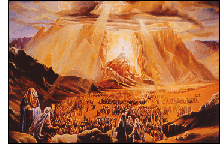 What an amazing phenomenon--the people SAW thunders and the sound of the ram's horn! No wonder they trembled and stood at a distance!
Exo 20:19 and said to Mosheh, "You speak with us and we hear, but let not Elohim speak with us, lest we die."
The people did not want to hear YHWH directly speaking to them and preferred to have Mosheh as their intermediary, but Mosheh explains that the manifestation of YHWH was for their good--so that they would not sin.
Eze 1:28 As the appearance of a rainbow in a cloud on a rainy day, so was the appearance of the brightness all around it. This was the appearance of the likeness of the esteem of יהוה. And when I saw it, I fell on my face, and I heard a voice of One speaking.
Yehezqel (Ezekiel) also experienced a magnificent manifestation of YHWH and fell on his face.
Hab 3:16 I heard, and my body trembled, My lips quivered at the sound, Rottenness came into my bones. And I trembled within myself, That I might rest for the day of distress, To come upon the people who would attack us.
Hababbuk also trembled and had fear of YHWH and empathy for those YHWH would take vengeance upon.
Fearing YHWH is essential because it comes from an understanding of the difference between He and us. If we are not careful, we can end up being far too casual with the King of Kings until we have brought Him down to our level in our own minds, and worse, even elevated ourselves above Him. Instead, we should always be mindful that He is the King, and we are His humble servants. If we humble ourselves, HE will lift us up. But if we are proud and arrogant, He will oppose us.
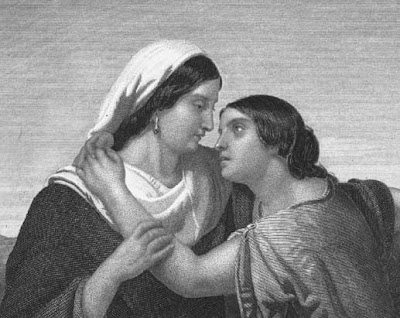 Ruth is a good example for us to follow. She chose to follow YHWH, the Elohim of Israel, instead of the false gods of her native country of Moab. She was humble and accepted the authority of her mother-in-law over her, doing as she advised, and because of her devotion, humility and virtue, she was blessed to be part of the bloodline into which the Messiah was born. The way Ruth clung to Naomi and the Elohim of Naomi is the same way we should cling to YHWH. It is customary to read the book of Ruth during Shavuot.
Even though we haven't experienced these more amazing kinds of manifestations, Yeshua has pronounced a special blessing on us:
Joh 20:29 Yeshua said to him, "T'oma, because you have seen Me, you have believed. Blessed are those who have not seen and have believed."
Even if we don't see and hear all the 'big' things, we can be quiet and listen for the still small voice of YHWH.
Jam 4:8a Draw near to Elohim and He shall draw near to you.
Labels:
The Scriptures
Beha'alotkha (In Your Making Go Up)
(This week's Torah Portion is Beha'alotkha, and I originally wrote and posted this to my previous blog on 06/26/2007.)
TORAH: Bemidbar (Numbers) 8:1-12:16
HAFTARAH: ZekarYah (Zechariah) 2:14-4:7
KETUVIM NETZARIM: 1 Corinthians 10:6-13; Revelation 11:1-19
Num 8:1 And יהוה spoke to Mosheh, saying,
Num 8:2 "Speak to Aharon, and say to him, 'When you set up the lamps, let the seven lamps give light in front of the lampstand.' "
Num 8:3 And Aharon did so. He set up the lamps to face toward the front of the lampstand, as יהוה commanded Mosheh.
Num 8:4 And this is the work of the lampstand: beaten work of gold, from its base to its blossoms it is beaten work. According to the pattern which יהוה had shown Mosheh, so he made the lampstand.
This lampstand is also called a menorah. It has 7 branches. There is a very large menorah outside of the Knesset building in Jerusalem-- The menorah is also included in the emblem of Israel standing between two olive branches--
 This is based on the vision in ZekarYah (Zechariah)--
Zec 4:11 Then I responded and said to him, "What are these two olive trees, one at the right of the lampstand and the other at its left?"
Zec 4:12 And I responded a second time and said to him, "What are these two olive branches which empty golden oil from themselves by means of the two gold pipes?"
Zec 4:13 And he answered me and said, "Do you not know what these are?" And I said, "No, my master."
Zec 4:14 And he said, "These are the two anointed ones, who stand beside the Master of all the earth."
These two are also described in Revelation--
Rev 11:3 "And I shall give unto my two witnesses, and they shall prophesy one thousand two hundred and sixty days, clad in sackcloth."
Rev 11:4 These are the two olive trees and the two lampstands that are standing before the Elohim of the earth.
There are two groups of people who use the menorah--the Jewish and Messianic believers in YHWH, the Elohim of Avraham, Yitshaq and Ya'acob. These are the remnants of the House of Yehudah and the House of Yisra'el.
 That the House of Yehudah and the House of Yisra'el are the two witnesses referred to in Revelation is confirmed in Yehezqel (Ezekiel)--
Eze 37:15 And the word of יהוה came to me, saying,
Eze 37:16 "And you, son of man, take a stick for yourself and write on it, 'For Yehudah and for the children of Yisra'el, his companions.' Then take another stick and write on it, 'For Yoseph, the stick of Ephrayim, and for all the house of Yisra'el, his companions.'
Eze 37:17 "Then bring them together for yourself into one stick, and they shall become one in your hand.
According to Strong's Concordance, the Hebrew word 'etz' translated as 'stick' in this passage from Yehezqel may more appropriately be translated as 'tree'. 'Etz' is the word translated 'tree' in references to the "tree of life".
The seven lampstands in Revelation are menorahs--
Rev 1:12 And I turned to see the voice which spoke with me. And having turned, I saw seven golden lampstands,
Rev 1:13 and in the midst of the seven lampstands One like the Son of Adam, dressed in a robe down to the feet and girded about the chest with a golden band.
Rev 1:20 "The secret of the seven stars which you saw in My right hand, and the seven golden lampstands: The seven stars are messengers of the seven assemblies, and the seven lampstands which you saw are seven assemblies.
These seven assemblies are not 'churches'. No Greek word meaning 'church' is used in the Ketuvim Netzarim ('New Testament'). The Greek word 'ekklesia' here translated as 'assembly' (and in some translations wrongly translated as 'church') was used to translate the Hebrew word 'qahal' in the Septuagint, a Greek translation of the Hebrew Scriptures ('Old Testament'), in about 280 B.C., and this word was used to refer to the people of Yisra'el.
The writers of the 'New Testament' had the same understanding of the word 'ekklesia' as the translators of the Greek Septuagint did--an assembly or congregation of the people of Israel.
Mosheh made the menorah "according to the pattern which YHWH had shown" him, so why did this pattern require seven branches in the menorah? Consider this--
Rev 1:4 Yohanan, to the seven assemblies that are in Asia: Favour to you and peace from Him who is and who was and who is coming, and from the seven Spirits that are before His throne,
There are seven Spirits before the throne of YHWH, and here we are given a description of them--
Isa 11:2 The Spirit of יהוה shall rest upon Him – the Spirit of wisdom and understanding, the Spirit of counsel and might, the Spirit of knowledge and of the fear of יהוה,
The seven branches of the menorah hold seven lights.
Mat 5:14a "You are the light of the world."
In order to be "the light of the world", we need to come out of the darkness and manifest the light of these 7 Spirits--
- The Spirit of YHWH.
- The Spirit of wisdom.
- The Spirit of understanding.
- The Spirit of counsel.
- The Spirit of might.
- The Spirit of knowledge.
- The Spirit of the fear of YHWH.
Mat 5:16 "Let your light so shine before men, so that they see your good works and praise your Father who is in the heavens."
Labels:
The Scriptures
Wednesday, June 11, 2008
A Redeemer
(This is the continuation and conclusion of Ruth--Grafted In, and I originally wrote and posted it to my previous blog on 03/13/2007.)
Reading: Ruth 3-4
Rth 3:9 And he said, "Who are you?" And she answered, "I am Ruth, your female servant. Now you shall spread your covering over your female servant - for you are a redeemer."
Rth 3:10 And he said, "Blessed are you of יהוה, my daughter! For you have shown more kindness at the end than at the beginning, not to go after young men, whether poor or rich.
Rth 3:11 "And now, my daughter, do not fear. All that you say I do for you, for all the people of my town know that you are a capable woman.
I've always thought this was such a tender scene. Ruth, in obedience to Naomi, her mother-in-law, appeals to Boaz to be their redeemer according to Torah:
Lev 25:25 'When your brother becomes poor, and has sold some of his possession, and his redeemer, a close relative comes to redeem it, then he shall redeem what his brother sold.
Before leaving Beyth Lehem, Naomi's husband had sold his land. Now, after the widows, Naomi and Ruth, have returned from Moab, they are in need of a kinsman redeemer. Boaz is touched by Ruth's appeal because apparently she had younger men to choose from, but he lets her know that there is a nearer kinsman than he, though he assures her that he will be her redeemer if the nearer kinsman refuses, and that is what happens.
Rth 4:14 And the women said to Naomi, "Blessed be יהוה, who has not left you this day without a redeemer. And let his Name be proclaimed in Yisra'el!
The book of Ruth ends with the genealogy from Perets to David, Ruth being David's great-grandmother.
Rth 4:18 And this is the genealogy of Perets: Perets brought forth Hetsron.
Rth 4:19 And Hetsron brought forth Ram, and Ram brought forth Amminadab.
Rth 4:20 And Amminadab brought forth Nahshon, and Nahshon brought forth Salmon.
Rth 4:21 And Salmon brought forth Bo'az, and Bo'az brought forth Obed.
Rth 4:22 And Obed brought forth Yishai, and Yishai brought forth David.
This genealogy is also the lineage of Yeshua Messiah. These 10 generations include at least 3 women who were not born Israelites. In addition to Ruth, who was a Moabitess, Boaz's mother was a Canaanite named Rahab, the woman who rescued the Israelite spies before the fall of Yericho, and the mother of Perets was Tamar, a Hittite. These previously gentile women became Israelites and shared in all the promises of the covenant, including the honor of helping to bring forth the Messiah, our Redeemer.
Labels:
The Scriptures
Monday, June 9, 2008
Ruth--Grafted In
(I originally wrote and posted this to my previous blog on 03/08/2007.)
Reading: Ruth 1 & 2
Rth 1:16 But Ruth said, "Do not urge me to leave you, or to go back from following after you. For wherever you go, I go; and wherever you stop over, I stop over. Your people is my people, and your Elohim is my Elohim.
Rth 1:17 "Where you die, I die, and there I shall be buried. יהוה do so to me, and more also - for death itself parts you and me."
These lines have been popular for use in wedding vows, and because of that, for a long time I thought it was actually a case of a woman speaking to the man she loved! As I actually read the book of Ruth, I discovered it was a daughter-in-law speaking to her mother-in-law. Wow! What a special woman Naomi must have been! And Ruth's devotion was amazing as well. When Naomi and Ruth, both widows, returned to Naomi's hometown, Beyth Lechem (Bethlehem), it could not have been easy to put food on the table. Ruth goes out to glean in the barley fields, so we know that this was in the spring around the time of Pesach (Passover). There, she finds favor with Boaz, the owner of the field, who makes sure she is watched over and that his workers leave plenty of barley for her to pick up.
 Ruth is an excellent example of how a gentile is grafted into Yisra'el. In the 10 years that Ruth was part of Naomi's family before they left Mo'ab, she must have learned a lot about YHWH and His Torah, so much so that she insisted on accompanying Naomi to her homeland rather than going back to her no doubt idolatrous family in Mo'ab. So she became a true Yisra'elite living by every word from the mouth of YHWH. Even so, she was still in need of a Redeemer..... (to be continued).
Labels:
The Scriptures
Friday, June 6, 2008
Nasso (Elevate!)
One of the more interesting instructions contained in this Torah portion is the procedure for the 'sotah'. A 'sotah' is a woman suspected of adultery.
The penalty for adultery is death:
Lev 20:10 'And a man who commits adultery with the wife of another man, who commits adultery with the wife of his neighbour: the adulterer and the adulteress shall certainly be put to death.
This could not have been an easy time for such a wife, especially if she was guilty. If she had any adultery to remember, I'm sure she would be remembering it as she was bringing this barley offering to the priest.
 Num 5:16 'And the priest shall bring her near, and shall make her stand before יהוה.
Num 5:27 'And when he has made her drink the water, then it shall be, if she has defiled herself and has committed a trespass against her husband, that the water that brings the curse shall enter her and become bitter, and her belly shall swell, and her thigh shall waste away, and the woman shall become a curse among her people.
Num 6:21 "This is the Torah of the Nazirite who vows to יהוה the offering for his separation, and besides that, whatever else his hand is able to provide. According to the vow which he takes, so he shall do according to the Torah of his separation."
Samson was set apart as a Nazirite from conception--
Jdg 13:3 And a Messenger of יהוה appeared to the woman and said to her, "See now, you are barren and have not borne, but you shall conceive, and you shall bear a son.
2Ki 1:7 And he said to them, "What was the man like who came up to meet you and spoke to you these words?"
Sha'ul (Paul) took a Nazirite vow--
Act 18:18 And Sha'ul, having stayed several days more, having taken leave of the brothers, was sailing for Syria, and Priscilla and Aqulas were with him, having shaved his hair at Kenhrea, for he had taken a vow.
Act 21:26 Then Sha'ul took the men on the next day, and having been cleansed with them, went into the Set-apart Place to announce the completion of the days of separation – until the offering should be presented for each one of them.
Labels:
The Scriptures
Wednesday, June 4, 2008
Rosh Chodesh 3--What Is In Your Heart?
(This evening the new moon is expected to be visible in Israel, which will begin the 3rd month of the Scriptural calendar. I originally wrote and posted this to my previous blog on 05/23/2007.)
Readings:
TORAH: Bemidbar (Numbers) 28:1-15
HAFTARAH: YeshaYahu (Isaiah) 66
KETUVIM NETZARIM: Kefa Alef (1 Peter) 2:4-10
These are the traditional readings for Rosh Chodesh.
Isa 66:3 "But whoever slaughters the bull slays a man; whoever slaughters the lamb breaks a dog's neck; whoever brings a grain offering – pig's blood; whoever burns incense blesses an idol. Indeed, they have chosen their own ways, and their being delights in their abominations.
Bulls, lambs, grain and incense are acceptable offerings to YHWH, but murdering a man, offering unclean animals to YHWH and worshipping idols are forbidden by YHWH, so why is YHWH equating them?
The difference is that bringing Him an acceptable offering while otherwise going our own way and delighting in abominations is no different to him than if we bring Him abominable offerings. If our heart is not perfect towards Him, then even an otherwise acceptable offering becomes an abomination!
Deu 8:2 "And you shall remember that יהוה your Elohim led you all the way these forty years in the wilderness, to humble you, prove you, to know what is in your heart, whether you guard His commands or not.
2Ch 16:9a "For the eyes of יהוה diligently search throughout all the earth, to show Himself strong on behalf of those whose heart is perfect to Him.
Psa 44:21 Would Elohim not search this out? For He knows the secrets of the heart.
Pro 11:20 The perverse of heart are an abomination to יהוה, But the perfect in the Way are His delight.
Mat 12:35 "The good man brings forth what is good from the good treasures of his heart, and the wicked man brings forth what is wicked from the wicked treasure.
Mat 15:8 'This people draw near to Me with their mouth, and respect Me with their lips, but their heart is far from Me.
Mar 12:33 "And to love Him with all the heart, and with all the understanding, and with all the being, and with all the strength, and to love one's neighbour as oneself, is more than all the burnt offerings and offerings."
1Ti 1:5 Now the goal of this command is love from a clean heart, from a good conscience and a sincere belief,
Heb 4:12 For the Word of Elohim is living, and working, and sharper than any two-edged sword, cutting through even to the dividing of being and spirit, and of joints and marrow, and able to judge the thoughts and intentions of the heart.
Heb 10:22 let us draw near with a true heart in completeness of belief, having our hearts sprinkled from a wicked conscience and our bodies washed with clean water.
YHWH does not want us to be double-minded or lukewarm.
Jam 4:8 Draw near to Elohim and He shall draw near to you. Cleanse hands, sinners. And cleanse the hearts, you double-minded!
Rev 3:16 "So, because you are lukewarm, and neither cold nor hot, I am going to vomit you out of My mouth.
He wants our whole heart, and isn't He entitled to that?
Rom 2:5 But according to your hardness and your unrepentant heart you are treasuring up for yourself wrath in the day of wrath and revelation of the righteous judgment of Elohim,
Rom 2:6 who "shall render to each one according to his works":
Rev 2:23 "And I shall slay her children with death. And all the assemblies shall know that I am the One searching the kidneys and hearts. And I shall give to each one of you according to your works.
It is only works that come from a pure heart that YHWH will reward with eternal life. An unrepentant heart only stores up wrath for the day of wrath.
Isa 66:4 "I shall also choose their punishments, and bring their fears on them. Because I called, but no one answered. I spoke and they did not hear, and they did evil before My eyes, and chose what was displeasing to Me."
Let us all cleanse our hearts and answer His call, listen to His words and choose what is pleasing to Him.
Labels:
The Scriptures
Monday, June 2, 2008
Yom Yerushalayim
 Today is Yom Yerushalayim (Jerusalem Day), which commemorates the reunification of Jerusalem during the Six-Day War in 1967 and the historical significance of Jerusalem for those who worship the Holy One of Israel.
Hebrew For Christians has a good article about Yom Yerushalayim here.
Labels:
The Scriptures
Friday, May 30, 2008
Bemidbar (In The Wilderness)
(This week's Torah portion is Bemidbar. I originally wrote and posted this to my previous blog on 05/24/2007.)
TORAH: Bemidbar (Numbers) 1:1-4:20
HAFTARAH: Hoshea (Hosea) 1:10-2:23
KETUVIM NETZARIM: Romans 9:22-33
Num 1:1 And יהוה spoke to Mosheh in the Wilderness of Sinai, in the Tent of Meeting, on the first day of the second month, in the second year after they had come out of the land of Mitsrayim, saying,
Num 1:2 "Take a census of all the congregation of the children of Yisra'el, by their clans, by their fathers' houses, according to the number of names, every male, head by head,
Num 1:3 from twenty years old and above, everyone going out to the army in Yisra'el. Number them by their divisions, you and Aharon.
YHWH directed Mosheh to take a census of Yisra'el, but only of the males 20 years old and older--those who were to serve in the army, and they numbered 603,550! Wow!
Num 1:45 And all those that were registered of the children of Yisra'el, by their fathers' houses, from twenty years old and above, everyone going out to the army in Yisra'el,
Num 1:46 all those that were registered were six hundred and three thousand five hundred and fifty.
This did not include males younger than 20, nor any of the females, nor the entire tribe of Levi--males and females, so you can imagine how many more people there were on top of that 603,550. They were like a huge city there in the wilderness!
With so many people, there had to be order, so YHWH instructed them in who was to camp where. The Levites were to camp around the Dwelling Place (Tabernacle) because YHWH had taken the Levites for Himself, so they were more set-apart than the rest of Yisra'el and were the caretakers and guardians of the Dwelling Place. The Levites acted as a buffer between YHWH and the people.
Num 1:52 "And the children of Yisra'el shall pitch their tents, everyone by his own camp, everyone by his own banner, according to their divisions,
Num 1:53 but let the Lewites camp around the Dwelling Place of the Witness, so that there be no wrath on the congregation of the children of Yisra'el. And the Lewites shall guard the duty of the Dwelling Place of the Witness." On the east, the direction in which the Dwelling Place faced, was the camping place of Mosheh and Aharon and their sons. Behind them were the tribes of Yehudah, then Yissaskar, then Zebulun, with Yehudah the leading tribe of those three.
On the south side of the Dwelling Place were the sons of Qehath of the Levites. Behind them were the tribes of Re'uben, then Shim'on, then Gad, with Re'uben being the leading tribe of the three.
On the west side of the Dwelling Place was the camping place of the sons of Gereshon of the Levites. Behind them were the tribe of Ephrayim, then Menashsheh, then Binyamin, with Ephrayim being the lead tribe.
On the north side of the Dwelling Place were the sons of Merari of the Levites. Behind them were the tribes of Dan, then Asher, then Naphtali, with Dan in the lead.
Num 2:1 And יהוה spoke to Mosheh and to Aharon, saying,
Num 2:2 "The children of Yisra'el are to camp, each one by his own banner, beside the sign of his father's house. Let them camp around the Tent of Meeting at a distance."
It was important for the people to camp in the proper order so that they were not too close to the Dwelling Place without preparation and authorization because the manifest presence of YHWH was there, and no sin or abomination can live in His presence.
When it was time to depart, the people on the west departed first--Yehudah, Yissaskar and Zebulun. They were followed by those on the south--Re'uben, Shim'on and Gad. Then came Mosheh, Aharon and the Levites carrying all of the parts of the Dwelling Place and all of its furnishings. The Levites could not carry the set-apart things until after Aharon and his sons had prepared and covered them first, and they could not even look on while Aharon and his sons did so lest they die. The Levites really did carry the burdens of the people!
The Levites remained in the midst of the people while they were traveling. The rear guard was then taken up by those who camped on the west--Ephrayim, Menashsheh and Binyamin. After them came the northern camp--Dan, Asher and Naphtali.
Num 1:54 And the children of Yisra'el did according to all that יהוה commanded Mosheh, so they did.
All of those in this huge number of people followed these intructions and protocols! It is difficult to imagine a city of that size of people of today behaving themselves in such an orderly fashion.
Num 3:10 "And appoint Aharon and his sons, and they shall guard their priesthood. And the stranger who comes near shall be put to death."
Only Aharon and his sons could serve as priests in the Dwelling Place. Anyone else was subject to death if they tried to go where only the priests were to enter. YHWH is set-apart, so only those set-apart can come near Him and that is because what is profane simply cannot exist in His presence.
Num 3:12 "Now look, I Myself have taken the Lewites from among the children of Yisra'el instead of every first-born who opens the womb among the children of Yisra'el. And the Lewites shall be Mine,
Num 3:13 because all the first-born are Mine. On the day that I struck all the first-born in the land of Mitsrayim, I set apart to Myself all the first-born in Yisra'el, both man and beast. They are Mine, I am יהוה."
The first-born among the children of Yisra'el were redeemed by the blood of the Passover lamb, so they belong to YHWH, but He chose to take the tribe of Levi for Himself in exchange.
Num 3:15 "Register the children of Lewi by their fathers' houses, by their clans. Register every male from a month old and above."
After numbering the other tribes of Yisra'el, YHWH instructs Mosheh to count every male 1 month old and older among the Levites.
Num 3:40 And יהוה said to Mosheh, "Register all the first-born males of the children of Yisra'el from a month old and above, and take the number of their names.
The first-born males of all the rest of the tribes 1 month old and older were also counted because the Levites were to be taken in exchange for them.
Num 3:41 "And you shall take the Lewites for Me – I am יהוה – instead of all the first-born among the children of Yisra'el, and the livestock of the Lewites instead of all the first-born among the livestock of the children of Yisra'el."
Num 3:44 And יהוה spoke to Mosheh, saying,
Num 3:45 "Take the Lewites instead of all the first-born among the children of Yisra'el, and the livestock of the Lewites instead of their livestock. And the Lewites shall be Mine, I am יהוה.
There was a discrepancy in the number of Levites compared to the number of the first-born of the rest of the tribes in that there were more first-borns than Levites, so this was resolved by paying a ransom for the 273 first-borns over the number of Levites. This silver went to the priesthood.
Num 3:46 "And for the ransom of the two hundred and seventy-three of the first-born of the children of Yisra'el, who are more than the number of the Lewites,
Num 3:47 you shall take five sheqels for each one, head by head – take it by the sheqel of the set-apart place, the sheqel of twenty gerahs.
Num 3:48 "And you shall give the silver, the ransom of those who are in excess among them, to Aharon and his sons."
Even though at this point in Yisra'el's history Mosheh was able to number them, it is prophesied in Hoshea that there will come a time when they will not be able to be counted.
Hos 1:10 "Yet the number of the children of Yisra'el shall be as the sand of the sea, which is not measured nor counted. And it shall be in the place where it was said to them, 'You are not My people,' they shall be called, 'You are the sons of the living El.'
Hos 1:11 "And the children of Yehudah and the children of Yisra'el shall be gathered together, and appoint for themselves one head, and shall come up out of the earth, for great is the day of Yizre'el!
This is because YHWH has so thoroughly sown the Yisra'elites among the nations of the earth that they have lost their identity.
Hos 2:23 "And I shall sow her for Myself in the earth, and I shall have compassion on her who had not obtained compassion. And I shall say to those who were not My people, 'You are My people,' while they say, 'My Elohim!' "
YHWH knows His people, and He calls them out so that they can prepare to be His bride.
Hos 2:19 "And I shall take you as a bride unto Me forever, and take you as a bride unto Me in righteousness, and in right-ruling, and kindness and compassion.
Hos 2:20 "And I shall take you as a bride unto Me in trustworthiness, and you shall know יהוה.
Sha'ul knew and understood the prophecies about the 'lost' tribes of Yisra'el, so he knew who the 'gentiles' were who were turning to YHWH and following Yeshua Messiah.
Rom 9:25 As He says in Hoshea too, "I shall call them My people, who were not My people, and her beloved, who was not beloved."
Rom 9:26 "And it shall be in the place where it was said to them, 'You are not My people,' there they shall be called sons of the living Elohim."
Rom 9:27 And Yeshayahu cries out on behalf of Yisra'el, "Though the number of the children of Yisra'el be as the sand of the sea, the remnant shall be saved.
Ya'acob (James) also knew to whom he was writing.
Jam 1:1 Ya'aqob, a servant of Elohim and of the Master Yeshua Messiah, to the twelve tribes who are in the dispersion: Greetings.
And so did Kepha (Peter).
1Pe 1:1 Kepha, an emissary of Yeshua Messiah, to the chosen, strangers of the dispersion in Pontos, Galatia, Kappadokia, Asia, and Bithunia,
1Pe 1:2 chosen according to the foreknowledge of Elohim the Father, set apart by the Spirit unto obedience and sprinkling of the blood of Yeshua Messiah: Favour and peace be increased to you.
The Greek word translated as "dispersion" means "to sow throughout", and that is exactly what YHWH said He would do:
Hos 2:23a "And I shall sow [Yisra'el] for Myself in the earth,
And if He has sown, He will also reap. This harvest is happening as more and more people are answering His call and coming out of the idolatry of false religious systems and turning back to the true worship of YHWH as reestablished by Yeshua Messiah and His apostles.
Labels:
The Scriptures
Wednesday, May 28, 2008
What is Love?
(I originally wrote and posted this to my previous blog 03/08/2007.)
Reading: Shir HaShirim (Song of Songs) 7 & 8 Son 8:6 Set me as a seal upon your heart, As a seal upon your arm; For love is as strong as death, Jealousy as cruel as the grave; Its flames are flames of fire, a flame of Yah!
Son 8:7 Many waters are unable to extinguish love, And floods do not wash it away. If one would give all the wealth of his house for love, It would be utterly scorned.
Love is a difficult thing to understand. We all want it, and all too often we take it for granted. The world defines love in ways that may or may not be in harmony with what YHWH teaches us in His Word.
And what about the sad line, "I love you, but I'm not 'in love' with you"? What is 'in love' other than infatuation, and could infatuation be true love? From what I've observed, infatuation doesn't last. Our culture builds a lot on this idea of infatuation as love. It is a gigantic industry with a wide scope from entertainment and fashion to literature and all points in between. But this thing that is called 'love' in reality is a very selfish conditional kind of thing.
When all my dreams of love were shattered, I went back to YHWH and asked Him what love is, and He showed me:
1Co 13:4 Love is patient, is kind, love does not envy, love does not boast, is not puffed up,
1Co 13:5 does not behave indecently, does not seek its own, is not provoked, reckons not the evil,
1Co 13:6 does not rejoice over the unrighteousness, but rejoices in the truth,
1Co 13:7 it covers all, believes all, expects all, endures all.
1Co 13:8a Love never fails.
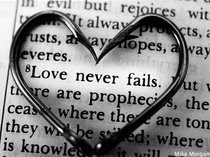 Most believers are familiar with this passage that teaches us what love is. Today I noted the similarity between this passage and the passage in Shir HaShirim above:
- Many waters are unable to extinguish love
- Love never fails
But so many of us have seen 'love' extinguished; we've witnessed the failure of 'love'. So, what is the truth--What YHWH says or what we have witnessed? If we believe that YHWH speaks Truth, then the only conclusion is that what we've seen extinguished or failed was not love.
The King James version translates the word 'love' in 1 Corinthians 13 as 'charity', and I believe that this gives us our biggest clue to what love truly is--
It is something we give to another with no expectation of anything in return.
Labels:
The Scriptures